
Toothaches never seem to come at a good time. For Rehan, a project manager in Al Quoz, it began as a sting with his morning karak, then became a dull ache he tried to ignore for six weeks. One night, it woke him at 2 am with a jaw so sore he could barely touch it. By the time he saw the dentist, he was sure his molar was lost.
But his X-ray told a different story. The outside of the tooth was strong; it was the soft tissue inside that had the problem. After two visits and a crown, his molar was working again. This guide will show how root canal treatment makes that possible, explain each step of the procedure, describe what recovery is like, and outline what affects the cost of a root canal in Dubai.
What Is a Root Canal Treatment, and Why Does the Pulp Get Infected?
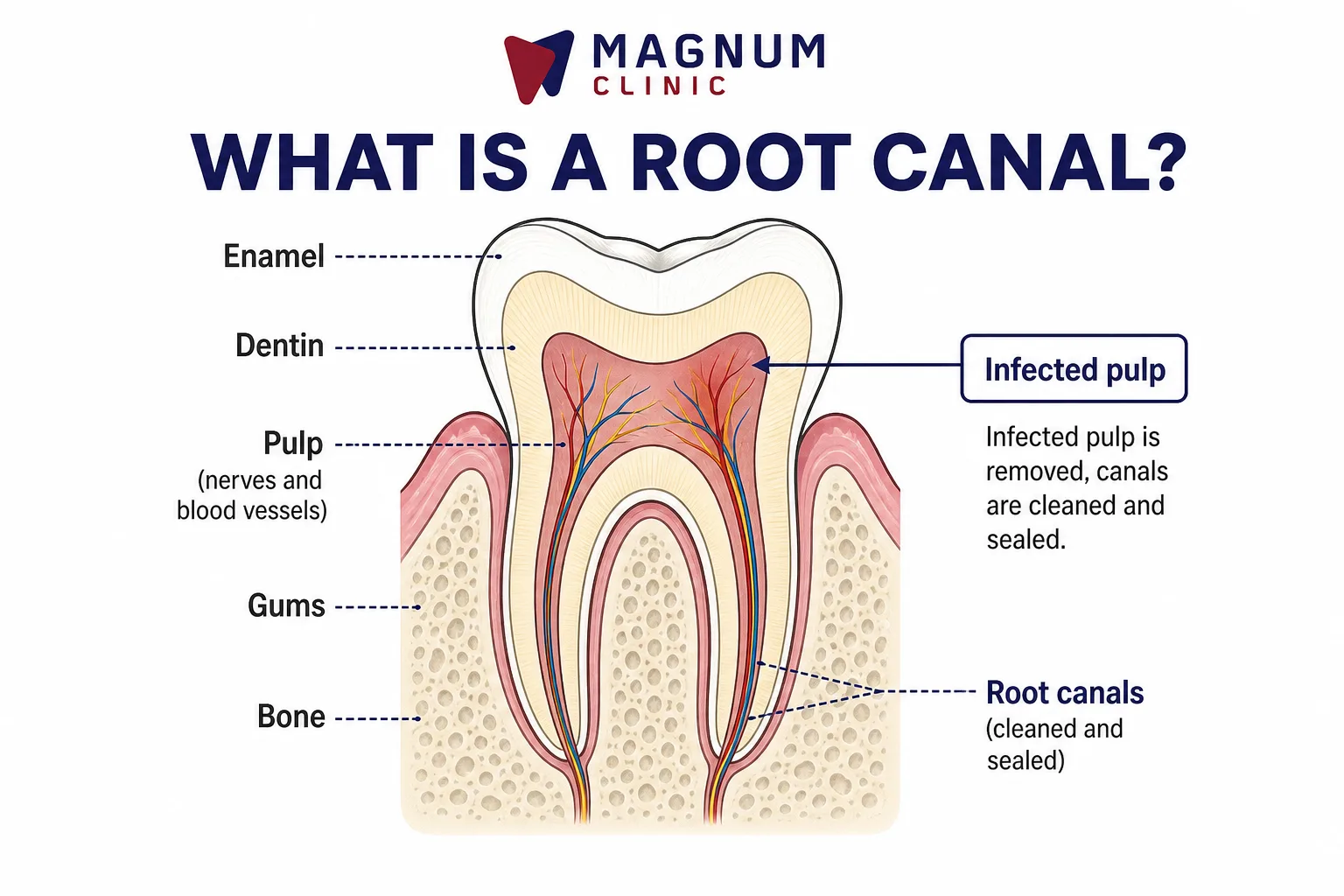
Every tooth has a soft centre called the pulp, which contains nerves, blood vessels, and connective tissue. The pulp sits in a chamber that extends down into narrow channels in each root. These channels are the 'canals' that give the procedure its name.
Root canal treatment, also called endodontic treatment, is needed when the pulp gets inflamed, infected, or too damaged to heal. The dentist removes the infected pulp, cleans and disinfects the canals, and seals the space so bacteria cannot return.
The pulp usually gets infected because of deep decay, a crack in an old filled tooth, an old injury, or repeated dental work on the same tooth. Once infected, it cannot heal by itself. Antibiotics might reduce swelling for a short time, but they cannot reach inside the sealed canals, so the damaged tissue must be removed by the dentist.
Signs You May Need a Root Canal
Symptoms differ from person to person, though certain patterns repeat:
- Pain that persists after something hot or cold, instead of fading in a second or two
- Sharp discomfort when biting down or when the tooth is tapped
- A deep pain that starts on its own, often worse at night
- Swelling or tenderness in the gum nearby, sometimes with a small bump that drains
- Darkening of one tooth compared with its neighbours
There is one detail that surprises many people. When the nerve dies completely, the pain can disappear for days or weeks, making it seem like the problem is gone. However, the infection at the root tip often continues quietly, so a tooth that was very painful and then stops hurting still needs to be checked by a dentist.
Root Canal Procedure Steps: What Happens in the Chair
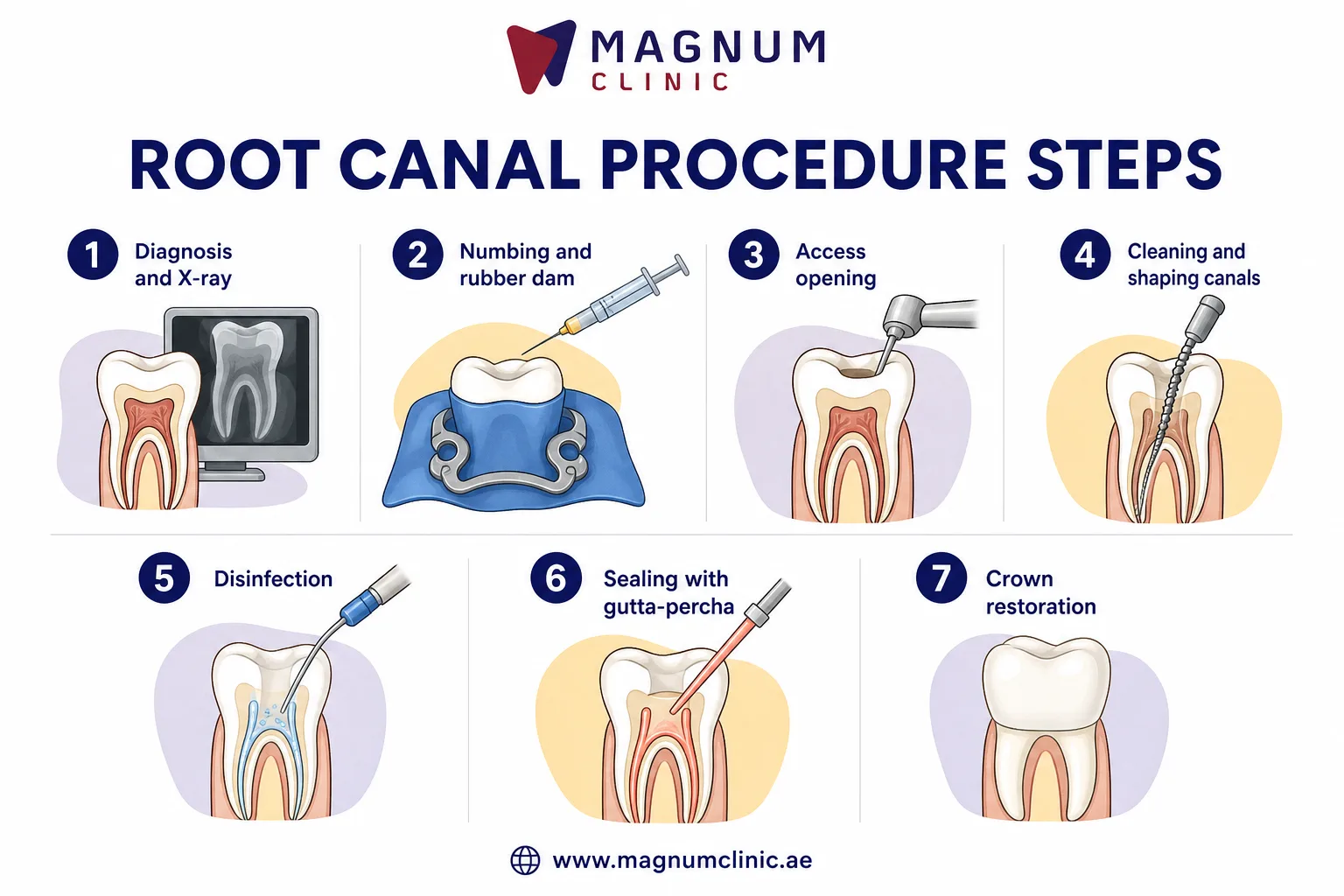
Most patients find that the actual procedure is easier than they expected. Here are the steps of a root canal, in order.
- Diagnosis and imaging. The tooth is examined and tested, and an X-ray is taken. Complex roots or retreatment cases may need a 3D CBCT scan first.
- Numbing and isolation. Local anaesthetic is given, then a thin rubber sheet called a dam is placed around the tooth to keep the area clean and dry.
- Access. A small opening is made through the biting surface to reach the pulp chamber.
- Cleaning and shaping. Fine flexible instruments remove the infected tissue and widen the canals, while an electronic apex locator measures each canal to its exact end.
- Disinfection. Rinsing solutions wash through the canal system to clear bacteria from areas instruments cannot physically touch.
- Sealing. Once dry, the canals are filled with a rubber-like material called gutta-percha and a sealer, closing the space off.
- Restoring the tooth. A filling closes the access opening, and most back teeth then receive a crown.
Some root canals can be completed in one visit. Others, especially molars with several canals or teeth with swelling, may need two appointments. In these cases, a medicated dressing is placed inside the tooth between visits.
Does a Root Canal Hurt?
Almost every patient asks about pain first, and the old reputation comes from a time before modern anaesthesia and tools. With proper numbing, the treatment is usually comfortable. Most of the pain people associate with root canals actually comes from the infection itself, and that pain goes away once the inflamed pulp is removed.
You might feel mild soreness when biting for a few days as the area around the root heals. Usually, simple painkillers recommended by your dentist are enough. If the pain gets worse after the first few days, call your dentist.
Why Saving Your Natural Tooth Is Worth It
A root canal does not kill the tooth. Instead, it removes the infection, relieves pain, and lets your natural tooth keep working for many years.
Your natural teeth are held in place by a ligament that cushions each bite and sends signals to your brain, helping you chew with control. No replacement can fully match this. Keeping your tooth also prevents nearby teeth from shifting into the gap, and the root helps keep the surrounding bone healthy. Treating a tooth usually means just one procedure, while removing it often leads to needing an implant or bridge later, which means more visits and higher costs.
Sometimes, extraction is still the best option, such as when a tooth is broken below the gum line. A dentist needs to examine the tooth to make the right decision, rather than guessing.
Crowns and Aftercare
A tooth that has had a root canal is more brittle than before, both because of the original decay and the opening made during treatment. Since back teeth handle strong chewing forces, a crown is usually recommended for them.
Until your crown is placed, try to chew on the other side and avoid hard or sticky foods. After the crown is fitted, keep brushing twice a day, clean between your teeth, and see your dentist for regular check-ups, because decay can still form around the edges of the crown.
Root Canal Cost in Dubai: What Changes the Number
There is no fixed price for a root canal, and any estimate given before an exam is just a guess. These are the main factors that affect the cost of a root canal in Dubai:
- Which tooth it is. Front teeth usually have one canal, while a molar can have three or four, so chair time differs.
- Canal anatomy. Curved, calcified, or extra canals take longer and may call for CBCT imaging.
- First treatment or retreatment. Reopening a treated tooth means clearing old filling material before the canals can be cleaned again. Magnum Clinic also offers re-root canal treatment when a previous root canal needs to be redone.
- The final restoration. Crowns are a separate stage with their own material choices, so budget for that from the start.
- Insurance. Many UAE plans cover endodontic treatment at least partly, though limits and co-payment percentages vary.
Schedule a consultation so your dentist can examine the tooth and explain the treatment plan step by step.
When to See an Endodontist in Dubai
Book an appointment if any of these apply:
- Pain lingers after hot or cold drinks.
- Biting on one particular tooth hurts.
- Swelling appears in the gum or face, which should be seen the same day.
- A tooth has darkened, or a small bump keeps returning on the gum.
- Earlier root canal treatment has started feeling uncomfortable again.
An endodontist is a dentist with advanced training who specialises in treating the pulp and root canal system. This expertise is especially helpful for teeth with narrow canals, retreatment cases, or teeth that other dentists consider hopeless.
Why Choose Magnum Dental Clinic in Dubai
- Specialists at one place: DHA-licensed endodontists, periodontists, oral surgeons, and general dentists work together, so treatment, crown, and follow-up happen in one place.
- Modern diagnostics: Digital X-rays, CBCT imaging where indicated, rotary instruments, and apex locators support accurate care.
- Open seven days a week, until late: Evening and weekend slots at select branches (up to 10 PM) fit around work.
- Four locations across Dubai: DSO (Mon to Sun, 10 AM to 10 PM), JVC (Mon to Sat, 10 AM to 10 PM, Sun 11 AM to 8 PM), Arjan (Mon to Sun, 11 AM to 8 PM), and JLT (Mon to Sun, 11 AM to 8 PM).
- We accept insurance and explain all costs upfront: We work with providers like AXA, MetLife, Mednet, and NAS, so you will know your coverage and costs before treatment starts.
Frequently Asked Questions
Q. Does root canal treatment hurt?
With modern anaesthesia and techniques, the procedure is generally comfortable. Mild soreness for a few days afterwards is normal and usually manageable.
Q. Why save the natural tooth instead of removing it?
Keeping your natural tooth helps maintain normal chewing, appearance, and function, while avoiding the need to replace it with an implant or bridge.
Q. How many visits does it take?
Many cases finish in one or two appointments. Molars with several canals, or teeth with active infection, sometimes need an extra visit with a dressing in between.
Q. Do I really need a crown afterwards?
For most back teeth, yes, because chewing forces there are high. Front teeth with small access openings are occasionally restored with a filling instead.
Q. What happens if an infected tooth is ignored?
Infection tends to spread into the bone around the root tip, causing swelling and further damage, and the tooth may become impossible to save. Early treatment keeps the options simpler.
Q. Can a treated tooth be treated again if it fails?
Yes. Re-root canal treatment reopens the tooth, clears the old filling material, cleans the canals again, and reseals them.
Book Your Root Canal Consultation at Magnum Dental Clinic
Rehan thought he would lose his molar, but he still uses it today.
Author byline: Written by Dr Jaya Gandhi, BDS, MDS (Endodontics). DHA-Licensed Endodontist, Root Canal and Re-Root Canal Treatments, Magnum Dental Clinic, Dubai.
DISCLAIMER: This article is for general information and does not replace a personal dental consultation. Every tooth and every patient is different, so please consult a qualified dentist for advice specific to your case.


