
Meet Anaira.
Anaira was four months pregnant and doing everything by the book. Prenatal vitamins, gentle walks along the Marina, folders of baby names. Then one morning she noticed a streak of pink on her toothbrush. She rinsed and moved on. A week later, the pink was there again, and her gums looked puffier than she recalled. Like many expecting mothers, she assumed the dentist was off-limits until after delivery, so she quietly put up with it for three more months.
She did not need to. What Anaira had was pregnancy gingivitis, one of the most common and most treatable conditions in dentistry, and the appointment she was postponing proved both safe and simple.
If any part of that sounds familiar, this guide is for you. It covers what pregnancy does to your teeth and gums, how to manage toothache during pregnancy, what dental care during pregnancy looks like at home and in the clinic, and exactly when and how to see a dentist while pregnant in Dubai.
What is Pregnancy Gingivitis and Why does Pregnancy affect your Teeth?
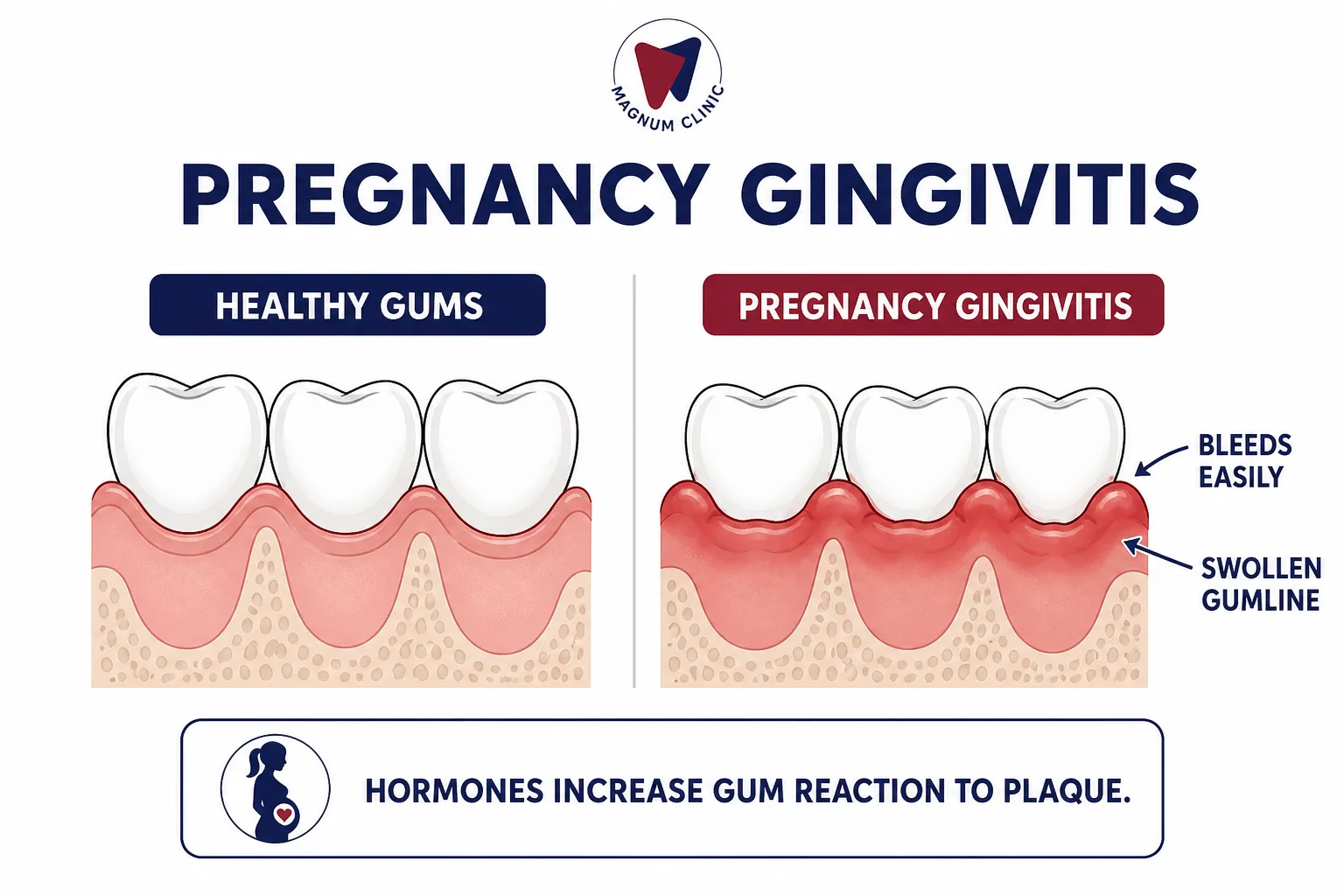
Pregnancy gingivitis is gum inflammation that starts or gets worse during pregnancy. Rising progesterone and oestrogen increase blood flow to the gums and make them far more reactive to ordinary plaque, so gums turn red, swollen, tender, and bleed easily, even with plaque levels that wouldn't bother you otherwise. Most pregnant women experience it, usually starting around the second month and peaking near the eighth. Dentists take it seriously because unmanaged gingivitis can progress to periodontal disease, a deeper infection that damages the bone holding your teeth. Gingivitis is reversible; periodontal disease is much harder to undo, so catching it early is everything.
Hormones aren't the only culprit. Pregnancy changes how you eat from frequent snacking, sugar cravings, and small repeated meals give cavity-causing bacteria more chances to do damage, which is why tooth decay risk rises too. And here's the part that matters beyond your own mouth: mothers with high levels of these bacteria can pass them to their baby after birth. Caring for your teeth now is genuinely an early investment in your child's.
Toothache and Teeth Pain during Pregnancy: What causes it and How to Ease It
Toothache during pregnancy usually comes from the same sources it does at any other time: a cavity, an inflamed gum, a cracked filling, or a wisdom tooth acting up. What changes during pregnancy is how quickly small problems grow. Inflamed gums are more sensitive, enamel softened by reflux wears faster, and a minor cavity in the first trimester can become a proper toothache by the third.
If you are dealing with teeth pain during pregnancy, here is a sensible order of operations:
- Rinse with warm salt water. It is simple, safe, and genuinely soothing for irritated gums.
- Keep the area clean. Pain often eases when trapped food and plaque are gently brushed and flossed away.
- Use a cold compress on the cheek for swelling.
- Do not self-prescribe. Some common painkillers are not recommended in pregnancy. Paracetamol is generally considered acceptable, but always confirm with your doctor or dentist before taking anything.
- Book an appointment rather than waiting it out. A toothache is your tooth asking for help, and untreated dental infections can affect more than just the tooth.
One thing worth saying plainly: enduring dental pain for months is not a requirement of pregnancy. Treatment for toothache during pregnancy is available, safe, and routine.
Bleeding Gums During Pregnancy: When it's Normal and When it's Not
Bleeding gums during pregnancy are common, and a little pink on the toothbrush from mild pregnancy gingivitis is rarely a cause for alarm. It typically improves with careful daily cleaning and settles after delivery.
That said, "common" is not the same as "ignore it." See a dentist if:
- Your gums bleed heavily or spontaneously, not just during brushing.
- The bleeding continues week after week despite good brushing and flossing.
- Your gums are pulling away from the teeth, or teeth feel slightly loose.
- You notice persistent bad breath alongside the bleeding.
Can you go to the Dentist while Pregnant?
Yes. This is probably the single most important message in this guide, because the belief that pregnant women should avoid the dentist keeps thousands of treatable problems untreated every year. Routine dental care during pregnancy, including check-ups and teeth cleanings, is considered safe in all trimesters. A professional cleaning is also one of the more reliable ways to stop pregnancy gingivitis from drifting toward periodontal disease while your hormones are working against you.
Timing still matters for comfort and for planning. Here is how dentists generally think about it:
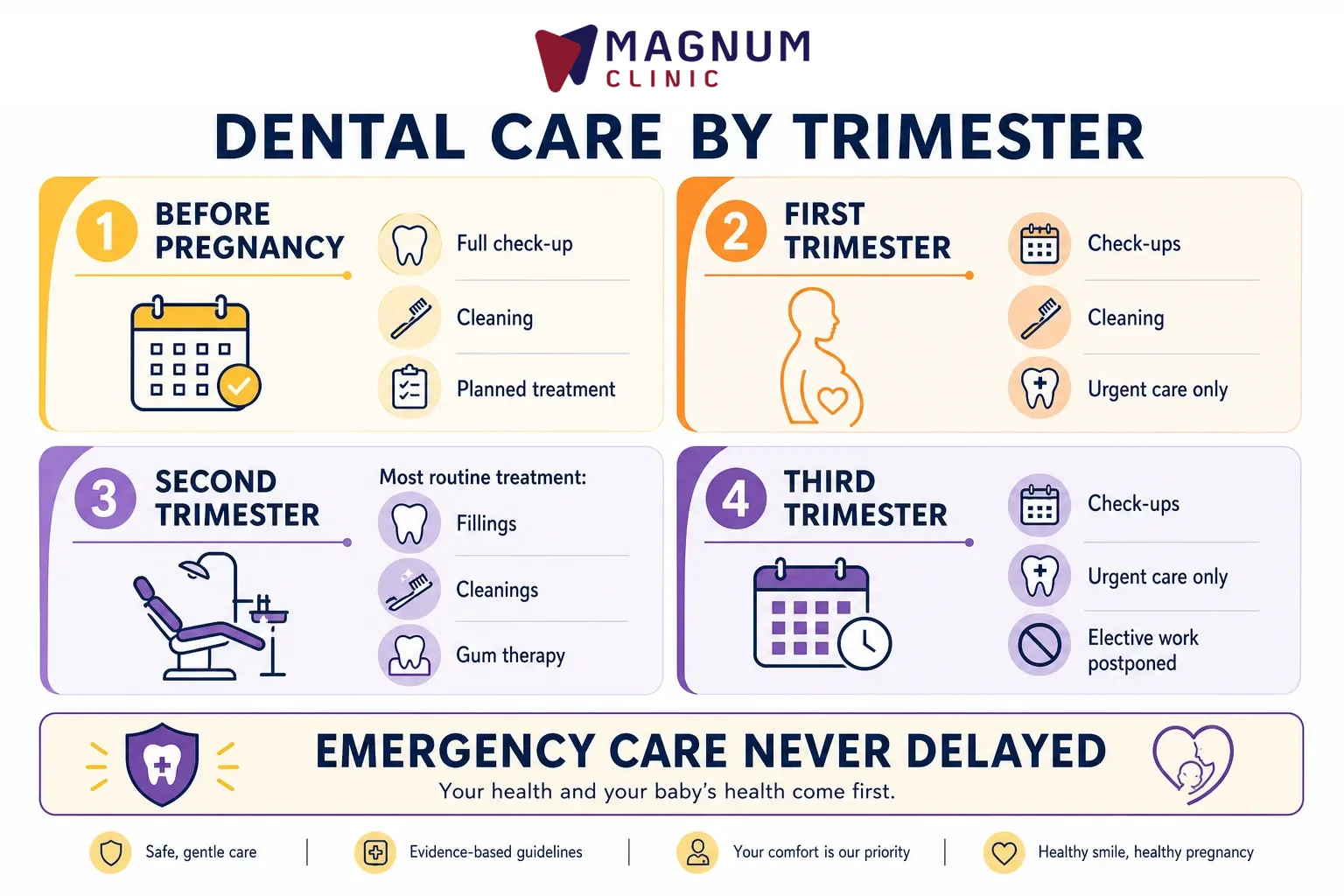
| Stage | What is usually done | Notes |
|---|---|---|
| Before pregnancy | Full check-up, cleaning, and any planned treatment | The ideal time to sort out fillings, extractions, and gum treatment |
| First trimester (weeks 1–12) | Check-ups, cleaning, urgent care only | Non-urgent procedures are usually deferred; nausea can make long visits uncomfortable |
| Second trimester (weeks 13–27) | Most routine treatment: fillings, cleanings, gum therapy | Generally the most comfortable window for dental treatment during pregnancy |
| Third trimester (weeks 28–40) | Check-ups, urgent care | Lying back for long periods becomes uncomfortable; elective work is usually postponed until after delivery |
| Any stage | Emergency treatment for pain, swelling, or infection | Never delayed because of pregnancy |
What about x-rays and anaesthesia?
Modern dental x-rays use very low doses of radiation, are aimed away from the abdomen, and are taken with a protective lead apron. When an X-ray is indeed necessary to diagnose a problem, it can be done during pregnancy. Dentists avoid unnecessary imaging, as they should for every patient.
Local anaesthetic used for fillings and other dental work is also considered safe in pregnancy at standard doses. If you need a filling, you do not need to feel it. Always tell your dental team that you are pregnant, how far along you are, and what medications or supplements you are taking, so all decisions can be adapted to you.
Common Dental Problems During Pregnancy: Epulis, Pregnancy Tumours and Enamel Erosion
Beyond gingivitis and toothache, a few conditions show up often enough in pregnancy to deserve their own introductions.
Pregnancy epulis (pyogenic granuloma). Some women develop a red, rounded growth on the gum that bleeds easily when touched. It is sometimes called a pregnancy tumour on gums, which is an unfortunate name, because it is not cancer and not dangerous. It is an overgrowth of inflamed tissue driven by hormones and plaque. Most shrink on their own after delivery. If one is bleeding, uncomfortable, or interfering with eating, a dentist can remove it.
Enamel erosion from vomiting and reflux. Morning sickness and reflux repeatedly bathe the teeth in stomach acid, softening and wearing away enamel and increasing the risk of decay. The counterintuitive rule: do not brush immediately after vomiting. Brushing acid-softened enamel can scratch it. Instead, rinse thoroughly with plain water, then follow with a fluoride mouthwash if you have one, or smear a small amount of fluoride toothpaste onto the teeth with a clean finger, and rinse. Wait about an hour before brushing.
Cravings for sugared snacks. Cravings are real, and nobody is asking you to fight biology all day. Where you can, reach for lower-sugar options, and rinse with water after sweet foods so sugar does not sit on the teeth between meals.
Gagging while brushing. Many pregnant women find that brushing, especially the back teeth, triggers gagging. Skipping those teeth is not the answer, but there are workarounds, covered below.
How to look after your Teeth during Pregnancy at Home
Daily habits do most of the heavy lifting in dental care during pregnancy. The routine is not complicated; it just needs actually to happen:
- Brush at least twice a day with a fluoride toothpaste, angling the bristles toward the gumline where plaque gathers.
- Floss once a day. With gums this reactive, the space between teeth is exactly where gingivitis and, later, periodontal disease begin.
- Eat a balanced diet and limit foods and drinks high in added sugar.
- Avoid tobacco products entirely and skip alcohol during pregnancy.
- Keep your routine dental visits. Every six months still applies, pregnant or not.
If brushing makes you gag
- Switch to a toothbrush with a small, soft head, even one made for toddlers.
- Slow down. Rushing makes gagging worse.
- Try closing your eyes and focusing on steady breathing, or brushing along to music as a distraction.
- If the toothpaste flavour is the trigger, change brands. As a temporary measure, brush with water and follow with a fluoride mouthwash, then return to fluoride toothpaste as soon as you can manage it.
After vomiting
Rinse with plain tap water, use a fluoride mouthwash or a smear of fluoride toothpaste on your finger, and wait about an hour before brushing. Your enamel will thank you for the patience.
Dental Treatment during Pregnancy in Dubai: Cost and What’s covered
Practical news for anyone reading this in the UAE: routine dental care during pregnancy in Dubai is accessible and reasonably priced, and most of what an expecting mother needs falls into the preventive category.
A realistic snapshot of the current Dubai market:
- Dental check-up and consultation: Around AED 100-300, with many clinics offering package rates.
- Scaling and polishing (teeth cleaning during pregnancy): Roughly AED 150 to AED 500 per session.
- A simple filling: From about AED 300, depending on size and material.
- Deep cleaning for periodontal disease (root planing): From about AED 400 per quadrant, when clinically needed.
- Management of a pregnancy epulis or other gum treatment varies by case, so ask for a quote at your consultation.
When to see a Dentist in Dubai During Pregnancy
Book an appointment if any of these apply:
- You are planning a pregnancy. A pre-pregnancy check-up lets you complete any needed treatment ahead of time, which is the most comfortable way to do it.
- Your gums bleed regularly, look swollen, or feel tender.
- You have a toothache, sensitivity, or pain that lasts more than a day or two.
- You notice a growth on your gums, however harmless it may turn out to be.
- Vomiting or reflux has been frequent, and you are worried about your enamel.
- It has been more than six months since your last check-up.
None of these requires panic, and all of them are easier to deal with sooner rather than later. Pregnancy is a nine-month project; your teeth should not have to wait it out.
Why Choose Magnum Dental Clinic in Dubai
- All specialists under one roof. DHA-licensed periodontists, endodontists, oral surgeons, and general dentists, so whether it's pregnancy gingivitis or a toothache, you see the right specialist without being referred elsewhere.
- Open 7 days a week, until late. With evening and weekend slots (up to 10 PM at select branches), you can fit dental care around work, prenatal appointments, and everything else.
- Pregnancy-adapted care at every step. From seating positions that keep you comfortable in the third trimester to treatment timing planned around your trimester, everything is adjusted for you and your baby, in accordance with DHA standards.
- Four locations across Dubai. DSO (Mon–Sun: 10 AM–10 PM), JVC (Mon–Sat: 10 AM–10 PM, Sun: 11 AM–8 PM), Arjan (Mon–Sun: 11 AM–8 PM), and JLT (Mon–Sun: 11 AM–8 PM).
- Insurance accepted, prices transparent. We work with major providers like AXA, MetLife, Mednet, and NAS, and you'll always know the cost before treatment begins, with same-day emergency care available at any trimester.
Frequently Asked Questions
Q. When does pregnancy gingivitis start and does it go away?
Gum inflammation can begin as early as the second month of pregnancy and often peaks around the eighth. With good daily cleaning and professional care, pregnancy gingivitis usually settles after delivery. Left unmanaged, it can progress to periodontal disease, which does not resolve on its own.
Q. What causes teeth pain during pregnancy?
The usual suspects are cavities, inflamed gums, cracked fillings, and wisdom teeth, all made more noticeable by hormone-related gum sensitivity and acid wear from reflux. Because pregnancy can accelerate the growth of small problems, tooth pain during pregnancy is worth investigating early rather than enduring it.
Q. How can I ease a toothache at home during pregnancy?
Rinse with warm salt water, keep the area clean, and use a cold compress for swelling. Check with your doctor or dentist before taking any painkillers. Home measures buy comfort, not a cure, so book an appointment for anything that lasts beyond a day or two.
Q. Are dental x-rays safe during pregnancy?
When clinically needed, yes. Dental x-rays use very low radiation doses, are directed away from the abdomen, and are taken with protective shielding. Your dentist will take only the images necessary for your diagnosis.
Q. Why are my gums bleeding during pregnancy?
Pregnancy hormones make gums more reactive to plaque, so bleeding gums during pregnancy usually point to pregnancy gingivitis. Gentle, thorough brushing and flossing typically improve it. A dentist should assess heavy, spontaneous, or persistent bleeding.
Book Your Pregnancy Dental Check-Up at Magnum Dental Clinic
Anaira waited three months longer than she needed to. You don't have to.
Author byline: Written by Dr Neeraja Varikuti, General Dentistry, Cosmetic Dentistry. DHA-Licensed General & Cosmetic Dentist at Magnum Dental Clinic, Dubai.
DISCLAIMER: This article is for general information and does not replace a personal dental or medical consultation. Every pregnancy is different, so please consult a qualified dentist and your obstetrician for advice specific to your case.


